• 10/100M Ethernet over E1 Converter 16E1 to 4 Ethernet Protocol Converter
  • 10/100M Ethernet over E1 Converter 16E1 to 4 Ethernet Protocol Converter

10/100M Ethernet over E1 Converter 16E1 to 4 Ethernet Protocol Converter

No.MR-4FE16E1

16E1 to 4-port Fast Ethernet converter supports GFP, LCAS and VLAN for stable transport over E1 lines, with optional optical uplink for ethernet switch and transceiver integration.

  • 10/100M Ethernet over E1 Converter 16E1 to 4 Ethernet Protocol Converter
  • Description

  • Applications

  • Specifications

Description

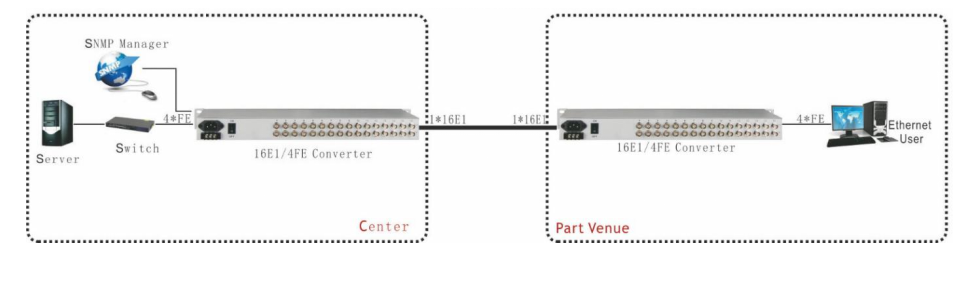
The device using reverse direction multiplexing technology to bundle for multiple E1 circuits to transmit the Ethernet data of 4Channel 100BASE-TX.It can realize 1~16 E1 channel to convert between Ethernet optical interface, to make E1 channels interconnected with Ethernet optical interface. Using GFP encapsulation, support the LCAS (link capacity adjustment scheme) and LAPS protocol. this device can support 1-16Channel E1 channel configuration, can automatically detect the number of E1 and select the E1 available. It allows E1 lines transmission time, 1channel/4channel/8channel/16channel Ethernet bandwidth is 1984Kbit/s,7936Kbit/s,15872 Kbit/s,31744Kbit/s.
The device provides alarm function. The work is reliable, stable, and low power consumption, high integration, small size. Support Network management , The main function of network management system is to fulfill the inquiry for local and remote devices and configuration management including inquiry of alarm status on E1 line, Ethernet working status, and loopback control etc.

High-Density E1-to-Ethernet Aggregation for Legacy Network Upgrades
This 10/100M Ethernet over E1 converter is built for operators, integrators, and industrial communication projects that need to transport Ethernet traffic across existing E1 infrastructure without replacing the entire transmission layer. It supports transparent Ethernet data transmission over 1 to 16 E1 circuits and converts 16E1 resources into 4 Ethernet interfaces, helping users extend IP services over traditional telecom lines in a practical and cost-aware way. For buyers evaluating solutions from industrial ethernet switch manufacturers, top network switch manufacturers, or optical transceiver manufacturers, this device offers a focused transport function that complements an ethernet switch, network switch, transceiver, or sfp module deployment where E1 access is still operationally important.

Protocol Efficiency, Adaptive Bandwidth, and Stable Network Control
The unit uses inverse multiplexing technology to bundle multiple E1 circuits for 4-channel 100BASE-TX Ethernet transmission, with support for GFP encapsulation, LCAS, and LAPS protocols to improve bandwidth use and link management across variable E1 availability. It can automatically detect the number of active E1 channels and select usable lines, supporting flexible 1 to 16 channel configuration with bandwidth options of 1984Kbit/s, 7936Kbit/s, 15872Kbit/s, and 31744Kbit/s based on line count. Ethernet ports support 10/100M adaptive transmission, full/half duplex, VLAN protocol, and AUTO-MDIX for straight-through or crossover cable adaptation, while optional optical Ethernet interfaces allow extended interconnection over fiber for projects that also involve an sfp module environment or coordination with optical transceiver manufacturers. Alarm monitoring, loopback control, and network management functions further support stable operation by enabling local and remote inquiry of E1 status and Ethernet working conditions.

Well-Suited for Carrier Access, Utility Networks, and Multi-Service Edge Sites
In real deployments, this converter is well-suited for telecom access upgrades, utility communication systems, transport corridors, industrial control networks, and remote branch interconnection where E1 circuits remain available but Ethernet service delivery is required. The integrated four-port electrical interface can reduce the need for an additional external network switch in some field installations, helping simplify cabinet design and lowering equipment count, while optional optical interfacing supports longer-distance uplinks into fiber-based aggregation layers. It is a practical choice for buyers comparing transmission devices alongside an ethernet switch or even a poe switch in broader network architecture, especially where dependable protocol conversion, compact footprint, low power consumption, and manageable deployment are more important than replacing legacy links before they are operationally necessary.

Features

  • Transparent transmission of Ethernet data in 1 to 16 E1 circuits;
  • Can be equipped with four Ethernet switching electrical interface for the user to save an Ethernet switch;
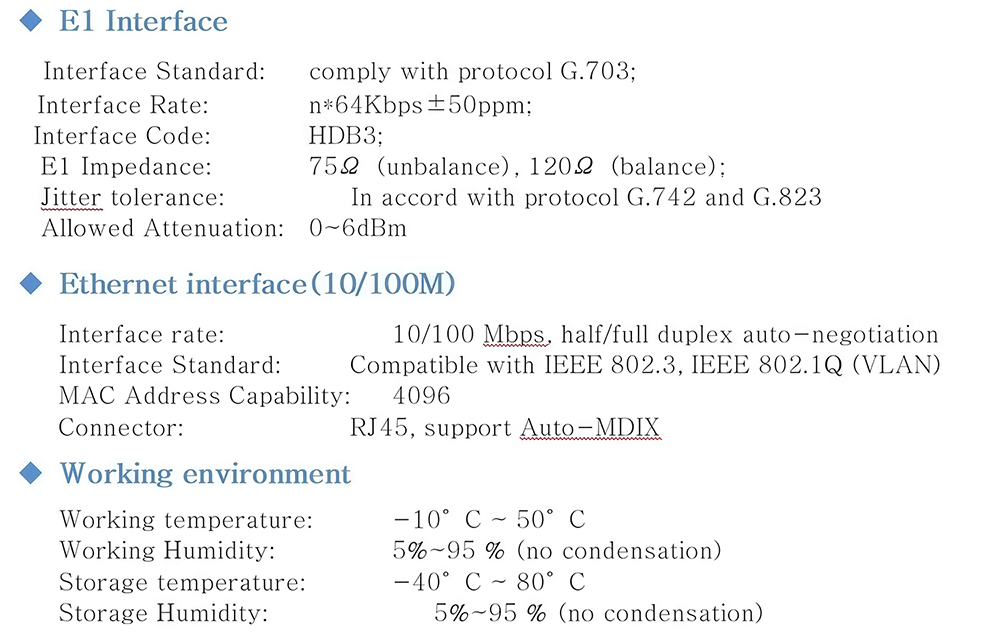
  • Ethernet 10/100M, full/half duplex fully adaptive, support VLAN protocol;
  • Each port supports Ethernet support AUTO-MDIX (crossover cable and straight-line adaptation);
  • Ethernet interface is also optional optical interfaces to achieve optical Ethernet data transmission through the interconnection E1 far;
  • 16-channel E1 lines, the maximum delay difference between any two can reach 220ms; when the delay difference over 220ms, the delay will produce poor overrun alarm, while business interruption;
  • Built dynamic Ethernet MAC address list (4096), with local data frame filtering function;
  • E1 interface complies with ITU-T G.703, G.704 and G.823, do not support the use of signaling slots;
  • Timer mode, the optional local timing and tracking E1 line timing, E1 line timing source can be automatically switched according to the signal quality. Such as E1 line timing source system for the first Road E1, when the first E1 failure (serious warning LOS/AIS/LOF/CRC4 or signal generating loopback) and the second path E1 is working properly, the system will automatically switch to the track The second road E1; elimination of the fault, the system then automatically return to the track first road E1;
  • Compliance with ITU-T standard protocol, GFP-F encapsulation suggestion G.7041, VCAT virtual concatenation and LCAS Link Capacity Adjustment recommendation G.7042, Ethernet mapping to nxE1 recommendation G.7043, Ethernet to single E1 map suggestion G. 8040;
  • When transmission bandwidth increases, will not damage the Ethernet data; transmission bandwidth is artificially reduced, it can also be realized without damaging the Ethernet data network;
  • E1 tributary ends may not correspond by serial connection;
  • When a single slip direction E1 fails, the other direction can still work;
  • E1 signal loop back and cut off the automatic detection function: When detecting the occurrence of a road E1 signal loop, the system cut off this E1; loopback released, E1 automatic recovery use this road;
  • Complete alarm indication, choose to display local / remote alarm;
  • Supports remote E1 line side loopback function to facilitate the testing of E1 lines;
  • Support local system for the remote system reset;
  • provide remote interface loopback command, easy to line maintenance;
  • Console management interface provides for easy installation opening;
  • Configuration network management module, support independent SNMP network management;
  • with this end in view the working status of remote device display function;
  • Multiple power mode options: AC220V, DC-48V / DC24V and the like;
  • DC-48V / DC24V power supply with automatic polarity detection function, when installed without distinction between positive and negative.


Key Advantages

Structured E1 Aggregation for Reliable Ethernet Extension
This protocol converter is built for networks that need to carry Ethernet traffic over existing E1 infrastructure without rebuilding the transmission layer. It supports transparent Ethernet transmission across 1 to 16 E1 circuits and automatically detects available E1 links, which helps engineering teams deploy bandwidth according to actual line conditions. By using GFP encapsulation with LCAS and LAPS support, the device provides a practical way to maintain stable service when E1 resources change, making it well-suited for telecom access, utility communication rooms, and other industrial environments that require controlled bandwidth delivery and dependable link behavior.

Flexible Interface Design for Integration and Maintenance
The unit can be equipped with four 10/100M Ethernet electrical switching ports, reducing the need for an additional network switch or ethernet switch at the edge. Each port supports full and half duplex adaptive operation, VLAN protocol, and AUTO-MDIX, which simplifies on-site cabling and improves compatibility with existing access devices. Optional optical Ethernet interfaces also make it practical to interconnect with fiber transmission equipment from optical transceiver manufacturers, transceiver platforms, or deployments using an sfp module, helping maintenance teams standardize interfaces and reduce troubleshooting time in mixed copper and optical networks.


Use Scenarios

Telecom and Carrier Access Node Deployment
In telecom equipment rooms, carrier access cabinets, and leased-line extension projects, operators often need to deliver Ethernet services across legacy E1 transmission resources while keeping network structure stable. This converter serves as the link adaptation device between multi-channel E1 circuits and Ethernet interfaces, allowing 4-channel 100BASE-TX data services to be carried through available E1 capacity. It fits this scenario because it supports adjustable 1 to 16 E1 channel configuration, alarm monitoring, and remote management functions that help technical teams maintain service continuity and manage distributed access nodes more efficiently than adding separate transmission and network switch equipment.

Industrial and Utility Communication Networks
In substations, rail communication sites, roadside control cabinets, and factory control rooms, users often need stable Ethernet transport over long-established E1 lines where replacing all equipment with a poe switch or systems from top network switch manufacturers is not always practical. This device works as a reliable conversion node that bridges industrial Ethernet access equipment to E1 transmission channels, while providing status inquiry, alarm visibility, and loopback control for maintenance teams. It is well-suited to these environments because its compact structure, low power consumption, and stable protocol conversion help preserve existing infrastructure while supporting practical Ethernet expansion for control, monitoring, and data collection systems.


FAQ

Q1. Can this converter integrate with our existing Ethernet network and E1 infrastructure?
Yes, we support integration between 1 to 16 E1 circuits and 4-channel 100BASE-TX Ethernet transmission. Our unit auto-detects available E1 links, supports 10/100M full/half duplex adaptive Ethernet, VLAN protocol, and AUTO-MDIX for practical deployment with your network switch environment.

Q2. Do you provide electrical and optical Ethernet interface options for different system designs?
The device can be equipped with four Ethernet switching electrical interfaces, which helps us reduce the need for an external ethernet switch in some topologies. We also offer optional optical Ethernet interfaces for long-distance interconnection over E1 transmission paths.

Q3. What bandwidth can we expect based on the number of E1 channels configured?
Bandwidth depends on the active E1 count. The unit supports 1, 4, 8, or 16 E1 channel transmission rates of 1984Kbit/s, 7936Kbit/s, 15872Kbit/s, and 31744Kbit/s respectively. We use reverse multiplexing with GFP encapsulation and support LCAS and LAPS for controlled link utilization.

Q4. How do we monitor alarms and operating status during deployment and maintenance?
Support for network management is built in. We provide inquiry and configuration functions for local and remote devices, including alarm status on E1 lines, Ethernet working status, and loopback control. Our design is intended for stable operation, low power consumption, and efficient maintenance oversight.

Q5. Is this product suitable if we want to simplify edge connectivity without adding extra transmission hardware?
In many installations, yes. Our converter combines 16-channel E1 capability with four Ethernet switching ports, allowing us to support compact deployments where fewer standalone devices are preferred. For buyers comparing industrial ethernet switch manufacturers, this unit is well-suited for protocol conversion rather than replacing all switching functions.


Functional Description

16E1-4xFE Converter , Ethernet can be divided into logical isolation , Encapsulated with GFP package, support LCAS and LAPS protocol,support independent SNMP network management;

Port Description

16*E1 interface;4 *FE Interface,one Console interface,one SNMP FE interface

Power

Power supply: AC180V ~ 260V;DC –48V;DC +24V

Power consumption: ≤10W

Dimension

Product Size: 19 inch 1U   485X138X44mm (WXDXH)

Weight

3.0KG

Download